
Key Takeaways:
- Automation is revolutionizing trading by enhancing efficiency and scalability.
- Human oversight remains crucial to navigate market complexities and ethical considerations.
- Emerging technologies like AI and machine learning are driving the evolution of automated trading systems.
The Rise of Automated Trading Systems
In recent years, automated trading systems have completely transformed global financial markets. By leveraging algorithms to execute orders based on predefined criteria such as time, price, and volume, these systems deliver unprecedented speed and efficiency in trading. The rapid execution capabilities of automated systems also contribute to greater market liquidity, making it easier for buyers and sellers to connect at any moment. Sophisticated platforms are now available that enable firms to integrate automation across all stages of the trading process, and you can learn more about how these solutions are powering the future of finance.
The effect of automation isn’t hypothetical. According to a 2019 study, trading algorithms were responsible for approximately 92 percent of all Forex transactions. This level of adoption underscores the shift from manual to automated processes, with technology driving both market participation and efficiency.
The transition to automation has improved trade execution, reduced human error, and provided professionals with valuable insights through advanced analytics. As these systems become more complex, they increasingly shape how financial products are traded around the world.
While speed is often highlighted as the main advantage, scalability and seamless integration across different asset classes are equally important. Trading desks that use automation can now process higher trade volumes efficiently, giving managers the agility to manage larger, more diverse portfolios.
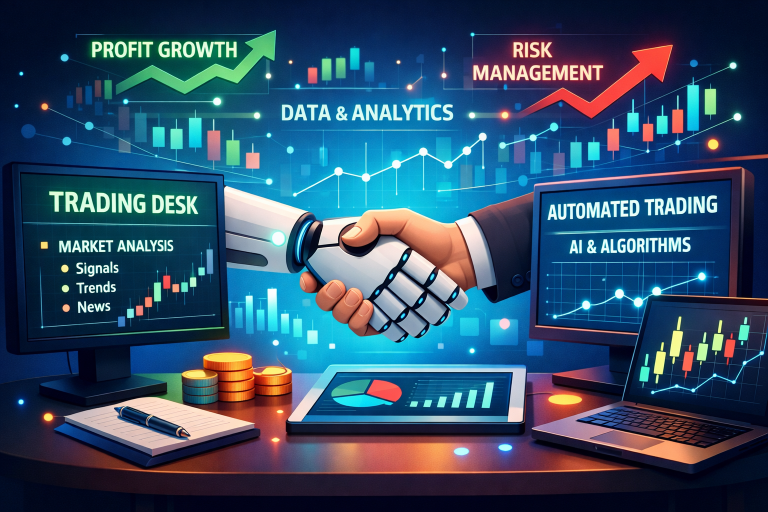
Benefits of Automation in Trading
The advantages of automation in the trading sector are significant and multifaceted. One of the clearest benefits is efficiency. Automated systems excel at processing immense data volumes in real time, reducing latency and bolstering market responsiveness. This translates into decreased trading costs and improved outcomes for both institutions and individual investors.
- Efficiency: Quick data processing and automated order execution yield faster and more consistent trades.
- Scalability: Traders can manage more accounts and trades with less manual oversight, allowing operations to grow rapidly without a proportional increase in resources.
- Risk Management: By following strict, predefined rules and mitigating impulsive human actions, automated trading can reduce mistakes and generate more predictable performance. According to the Financial Times, these systems also assist with robust compliance and risk-avoidance protocols.
The Role of Human Traders in an Automated World
The shift to automation does not eliminate the need for human traders. While technology handles repetitive and data-heavy trading functions, humans remain central to critical thinking, creative strategy development, and crisis management. Market volatility and unforeseen events still require nuanced judgment and expertise.
Human oversight is essential not only for interpreting market signals and managing exceptions but also for ensuring ethical standards are upheld. Experts emphasize the importance of combining automation with human insight, noting the risk of relying solely on machine-driven decisions.
Additionally, human traders play a key role in adapting strategies to new regulatory environments and rapidly shifting macroeconomic trends, areas where automation may fall short. Many firms are now prioritizing continuous education and training for their staff to maximize the synergy between human skills and advanced technology, reinforcing the critical link between analytical expertise and automation tools. As the landscape evolves, a hybrid approach becomes important for fostering resilience and driving long-term success.
Integration of AI and Machine Learning
The next stage in trading automation is being driven by artificial intelligence and machine learning. These technologies enable intelligent algorithms to evaluate large, complex datasets, discover patterns, and make predictive decisions that traditional models cannot. As a result, AI-powered platforms are improving strategies, enhancing backtesting accuracy, and offering more advanced risk controls. According to a survey by JPMorgan Chase & Co., a majority of professional traders expect AI and machine learning to be the most influential technology trends in the coming years.
As these technologies mature, they help trading firms stay competitive by identifying subtle market shifts and automating responses in near real time. The race to develop smarter, adaptive algorithms is reshaping trading as we know it.
Increasingly, integrating deep learning models enables processing of non-traditional data sources, such as news sentiment and social media, to inform strategic decisions. This broader analytical reach is helping traders anticipate market movements with greater precision. The competitive advantage achieved by incorporating machine learning is rapidly establishing new standards for what is possible in quantitative finance, driving both innovation and complexity across the sector.
Challenges and Considerations
Even with its broad advantages, automation introduces unique challenges. Over-reliance on technology makes markets vulnerable to algorithmic errors or system failures, which can amplify volatility during periods of instability. Regulatory frameworks must evolve to address the new risks associated with high-frequency automated trading and to ensure fair, transparent markets.
- Overreliance on Technology: Automation can amplify small errors across markets, underscoring the need for human monitoring.
- Ethical and Regulatory Issues: Regulators face challenges in maintaining fairness while addressing market manipulation risks and systemic vulnerabilities introduced by automation.
- Need for Continuous Monitoring: Automated systems must be carefully supervised and updated as markets evolve and new risks emerge.
Future Outlook
Looking ahead, the most resilient trading organizations will blend advanced automation technologies with human expertise. Those who can leverage both stand to benefit from greater efficiency, lower costs, and more agile decision-making, while mitigating the risks of market shocks and technological failures.
As new generations of AI-driven tools and automated trading systems are introduced, financial professionals and regulators must work together to foster innovation while establishing safeguards. By balancing automation with ethical standards and human judgment, the industry can achieve a sustainable, dynamic trading future.
The continued evolution of automation will shape global markets for years to come, with the potential to boost performance, increase market access, and help professionals manage complexity. Firms and traders who adopt emerging tools early are poised to stay ahead as trading becomes more data-driven and intelligent.
Ultimately, the fusion of technology and human acumen is redefining what is achievable within modern trading environments. The adaptability of teams and their willingness to experiment and innovate responsibly will be central to capturing the benefits of this fast-evolving landscape. As industry standards rise and competition intensifies, organizations that champion both technical advancement and ethical practice will be best positioned to thrive in tomorrow’s markets.