
Introduction: Defining the Commercial Construction Landscape

It is a distinct field. It differs greatly from building single-family homes or specialized industrial plants. Commercial construction focuses on creating spaces where businesses thrive and people gather.
This sector is a major driver of our economy. It provides countless jobs and builds the foundations for businesses and public services. Commercial projects can vary immensely in size. They range from small interior renovations to vast, multi-story developments. Both private companies and public institutions rely on this essential work.
In this extensive guide, we will explore this fascinating landscape. We will uncover the strategies, processes, and powerful machinery that bring these complex visions to life. Join us as we define modern development.
Commercial construction is primarily concerned with the planning, design, and construction of structures intended for commercial purposes. This includes everything from office buildings, retail spaces, and restaurants to hotels, medical facilities, and educational institutions. Unlike residential construction, which focuses on homes and living spaces, or industrial construction, which builds specialized facilities for manufacturing and heavy industry, commercial projects are designed for business operations and public interaction.
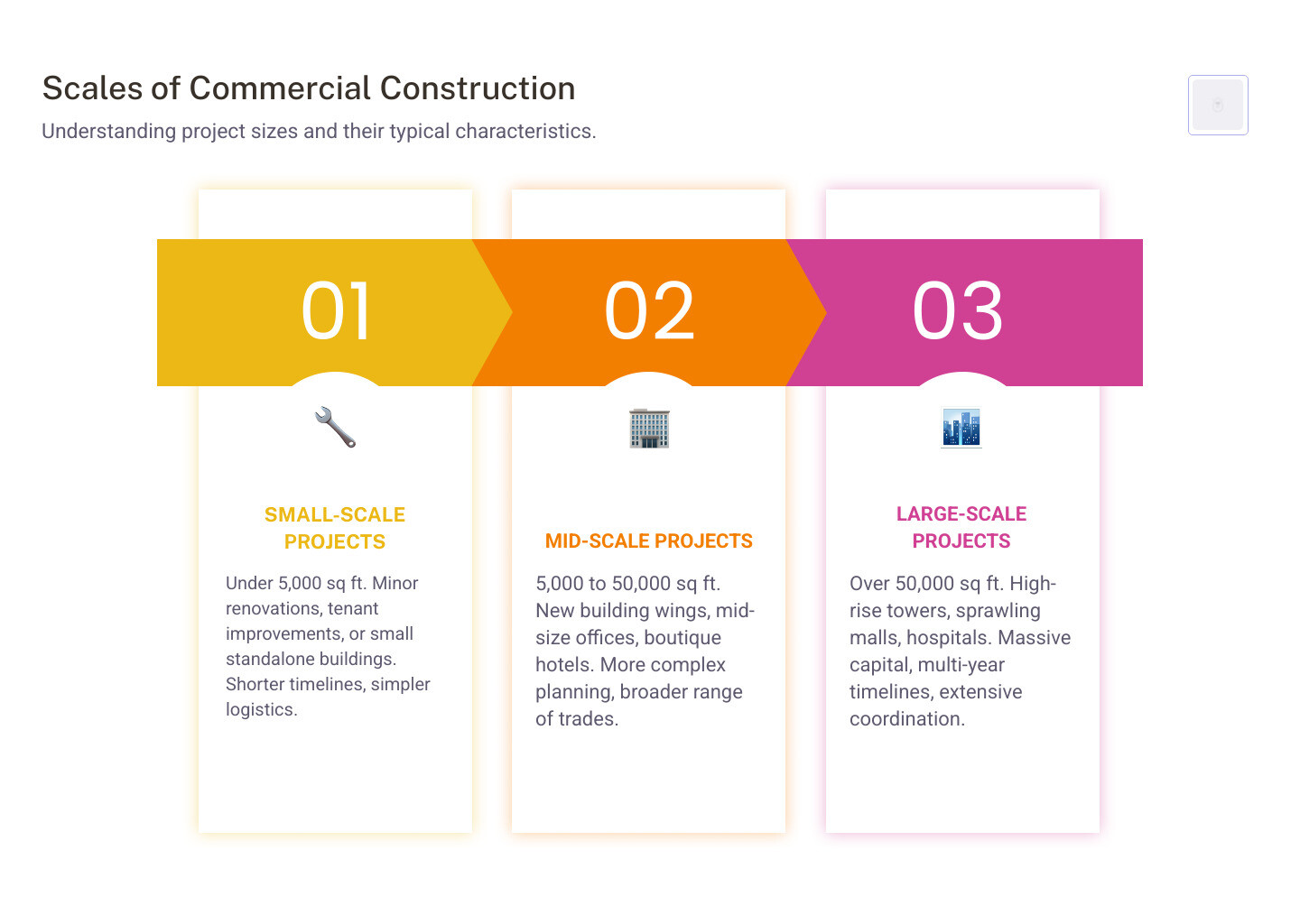
The scale of these projects can vary dramatically, influencing everything from the budget and timeline to the complexity of the regulatory compliance. We categorize commercial construction into three main scales:
- Small-Scale Projects: These typically involve minor renovations, tenant improvements, or new construction under 5,000 square feet. Examples include updating a retail storefront, remodeling an office interior, or building a small standalone restaurant. They usually have shorter timelines and require less heavy equipment.
- Mid-Scale Projects: Ranging from 5,000 to 50,000 square feet, these projects are more complex. They might involve constructing a new wing for an existing building, building a mid-size office complex, or developing a boutique hotel. These projects demand more intricate planning, a larger project team, and a broader range of specialized trades.
- Large-Scale Projects: These are extensive undertakings, often exceeding 50,000 square feet, and can include high-rise office towers, sprawling shopping malls, hospitals, or large mixed-use developments. They involve significant capital investment, multi-year timelines, and highly coordinated efforts from numerous stakeholders. These projects often involve starting from scratch, requiring comprehensive architectural plans and state-of-the-art construction techniques.
The economic impact of commercial construction is substantial, driving innovation, employment, and urban development. It’s a sector that constantly adapts to new technologies, evolving market demands, and stringent regulatory frameworks.
The Blueprint for Success: Key Project Stages from Concept to Completion
Bringing a commercial construction project to fruition is a complex journey that follows a well-defined project lifecycle. From the initial spark of an idea to the final handover of keys, each stage is critical for ensuring a successful outcome. This journey typically spans several phases: development and planning, pre-construction, procurement, the construction phase itself, and finally, post-construction and closeout.
Throughout these stages, a diverse group of professionals—the key stakeholders—collaborates closely. These typically include:
- Owner/Client: The individual or entity commissioning the project.
- Architect/Designer: Responsible for the aesthetic and functional design.
- Engineers (Structural, Mechanical, Electrical, Civil): Provide specialized technical expertise.
- General Contractor: Oversees the entire construction process, manages subcontractors, and ensures adherence to plans and schedules.
- Subcontractors: Specialized trades (e.g., electricians, plumbers, masons) who perform specific parts of the work.
- Project Manager: Ensures the project stays on track, on budget, and meets specifications.
- Local Authorities/Regulators: Responsible for permits, inspections, and code compliance.
The Development and Design Phase
Every commercial construction project begins long before the first shovel breaks ground. The development and design phase is where the vision is conceptualized, refined, and translated into a tangible plan. This stage typically involves:
- Feasibility Studies: An initial assessment to determine the viability of a project, considering market demand, site conditions, regulatory problems, and potential financial returns.
- Site Selection and Acquisition: Identifying and securing the optimal location, which often involves complex negotiations and due diligence. The role of developers and owners in shaping projects, often managed by firms specializing in Basin Street commercial real estate, is paramount during this critical phase. Their expertise in property evaluation and strategic planning sets the foundation for success.
- Schematic Design: Architects and designers create initial sketches and conceptual drawings, outlining the building’s layout, form, and general aesthetic. This is an iterative process, involving close collaboration with the owner to ensure the design aligns with their functional and aesthetic requirements.
- Budgeting and Cost Estimation: Developing preliminary cost estimates based on the schematic design, which will be refined as the design progresses. This helps in securing financing and making informed decisions about materials and systems.
- Contract Documents: Once the design is finalized, detailed construction drawings and specifications are prepared. These documents form the basis of the construction contract, providing precise instructions for how the building will be constructed.
This phase is crucial for laying a solid foundation. Errors or omissions here can lead to costly changes and delays down the line, emphasizing the need for meticulous planning and expert input.
The Construction and Closeout Phase
With plans finalized and contracts in place, the project moves into the physical construction and subsequent closeout phases.
- Site Preparation: This involves clearing the land, grading, excavation, and establishing necessary utilities. It also includes setting up temporary facilities for the construction crew and equipment.
- Execution of Plans: This is where the building takes shape. Foundations are laid, structural frameworks are erected, and the building envelope (walls, roof) is enclosed. Following this, interior work commences, including mechanical, electrical, and plumbing (MEP) systems, finishes, and fixtures.
- Quality Control and Safety Management: Throughout construction, rigorous quality control measures are implemented to ensure that all work meets the specified standards. Safety is paramount, with strict protocols and regular inspections to protect workers and the public.
- Inspections and Approvals: Various inspections are conducted by local authorities at different stages to ensure compliance with building codes, zoning laws, and safety regulations. Obtaining these approvals is essential for the project to proceed and ultimately receive an occupancy permit.
- Punch Lists: As construction nears completion, a “punch list” is created, detailing minor deficiencies or unfinished items that need to be addressed before final handover.
- Final Handover: Once all work is complete, inspected, and approved, the building is officially handed over to the owner. This includes providing all necessary documentation, warranties, and operational manuals.
The successful navigation of these phases requires exceptional project management, clear communication, and a proactive approach to problem-solving.
The Business of Building: Contracts, Costs, and Financial Strategy

The financial and contractual aspects of commercial construction are as intricate as the physical building process. Understanding the bidding process, accurate cost estimation, robust financial management, and the nuances of construction contracts are vital for any project’s success. These elements dictate profitability, manage risk, and ensure all parties are aligned on expectations and responsibilities.
Essential Elements of a Commercial Construction Contract
A commercial construction contract is a legally binding agreement that outlines the terms and conditions between the owner and the contractor. A well-drafted contract protects all parties and minimizes disputes. Key elements typically include:
- Project Scope: A detailed description of the work to be performed, including specifications, drawings, and deliverables.
- Project Cost and Payment Schedule: The total cost of the project and a clear breakdown of how and when payments will be made, including provisions for retainage (a percentage of payment held back until project completion).
- Timeline and Milestones: The project schedule, including start and completion dates, and key milestones.
- Change Order Procedures: A process for managing any modifications to the original scope of work, including how changes will be priced and approved.
- Warranties and Guarantees: Assurances regarding the quality of materials and workmanship.
- Insurance and Indemnification: Details of insurance coverage required from both parties and provisions for liability.
- Dispute Resolution: Mechanisms for resolving conflicts, such as mediation or arbitration.
- Legal Responsibilities: Outlining the obligations and rights of all parties involved, including compliance with all applicable laws and regulations.
A significant distinction in contract types lies between Design-Build and Traditional (Design-Bid-Build) approaches:
Feature Design-Build Traditional (Design-Bid-Build) Contract Type Single contract with one entity for both design & construction Separate contracts for design (architect) & construction (contractor) Responsibility Single point of responsibility for entire project Owner manages separate contracts for design & construction Project Flow Overlapping design & construction phases (fast-track) Sequential: Design completed, then bid, then construction Risk Allocation Contractor assumes more design & construction risk Owner assumes design risk; contractor assumes construction risk Communication Streamlined, direct between owner & design-build team Owner acts as intermediary between designer & contractor Cost Control Early cost certainty, potential for value engineering Cost determined after design, potential for change orders Timeline Generally faster due to overlapping phases Generally longer due to sequential phases Understanding the Costs of Commercial Construction
The cost of commercial construction can vary widely, making accurate estimation a critical skill. Several factors significantly influence the final price tag:
- Cost per Square Foot: This is a common metric, but it’s an average that masks significant variations. For example, a basic warehouse might cost $75-$150 per square foot, while a high-end medical facility could be $500-$1000+ per square foot.
- Location: Construction costs are heavily influenced by geographic location. Factors like local labor rates, material availability, permitting fees, and regional regulations can cause a project in a major metropolitan area to be significantly more expensive than an identical project in a rural region.
- Building Type: The intended use of the building is a primary cost driver. A retail store has different requirements than a hospital, an office building, or a manufacturing plant. Specialized systems (e.g., medical gas lines, heavy-duty HVAC, advanced security) add complexity and cost.
- Materials: The choice of structural materials (steel, concrete, wood), exterior finishes (brick, glass, metal panels), and interior components (flooring, cabinetry, fixtures) directly impacts cost. High-quality, durable, or custom materials will increase expenses.
- Finishes: The level of interior finishes, from basic to luxurious, can dramatically affect the budget. High-end lobbies, custom millwork, advanced lighting systems, and premium flooring all contribute to higher costs.
- Labor Costs: Skilled labor is a significant component of construction costs. Union wages, local demand for trades, and the complexity of the work all play a role. Labor shortages can drive up costs and extend timelines.
Effective cost management involves detailed budgeting, continuous monitoring, and proactive identification of potential overruns. This often includes building in contingency funds (typically 5-10% of the project cost) to account for unforeseen challenges.
The Machinery and Materials of Modern Development

The physical realization of a commercial construction project relies heavily on a combination of advanced material science and powerful, specialized machinery. These elements are the backbone of modern development, enabling the creation of durable, functional, and aesthetically pleasing structures that meet contemporary demands.
The Role of Heavy Equipment and Specialized Tools
Commercial construction sites are dynamic environments, often busy with an array of heavy equipment, each designed for specific tasks that would be impossible or impractical to perform manually.
- Excavators and Bulldozers: These are fundamental for site preparation, including earthmoving, digging foundations, and grading the land. Their power and versatility are essential for shaping the terrain to the project’s specifications.
- Tower Cranes: Dominating the skyline of large-scale projects, tower cranes are indispensable for lifting heavy materials like steel beams, concrete panels, and large equipment to significant heights. Their ability to reach across vast construction sites makes them critical for the vertical growth of buildings.
- Pavers and Rollers: For projects involving extensive roadways, parking lots, or large floor slabs, pavers lay asphalt or concrete efficiently, while rollers compact surfaces to ensure stability and durability.
- Specialized Lifting Solutions: Beyond standard cranes, the necessity of specialized commercial construction lifting solutions for high-rise and large-scale structures cannot be overstated. This includes mobile cranes, rough-terrain cranes, and even custom-engineered lifting systems designed for unique project challenges, ensuring the safe and precise placement of massive structural components.
- Technology in Machinery: Modern construction equipment increasingly integrates technology such as GPS for precise grading, telematics for remote monitoring and maintenance, and automation features that improve efficiency and safety. This technological integration helps optimize operations, reduce fuel consumption, and improve overall project control.
The selection and deployment of the right equipment are crucial for maintaining project schedules, ensuring safety, and managing costs effectively.
Choosing the Right Building Materials
The choice of building materials is a foundational decision that impacts a project’s structural integrity, cost, timeline, and long-term performance. Key considerations include:
- Durability: Commercial buildings are designed for longevity and heavy use, so materials must withstand wear and tear, environmental factors, and potential impacts.
- Cost-Effectiveness: Balancing upfront material costs with long-term maintenance, energy efficiency, and lifecycle costs is vital.
- Sustainability: A growing focus on environmental responsibility leads to the selection of recycled, renewable, or locally sourced materials, as well as those that contribute to energy efficiency.
- Fire Resistance: Commercial buildings must adhere to stringent fire safety codes, making fire-resistant materials a priority for structural components and finishes.
The Advantages of Steel and Pre-engineered Metal Buildings: Steel is a dominant material in commercial construction due to its strength-to-weight ratio, design flexibility, and durability. It allows for large, open spans and can be rapidly erected.
Pre-engineered metal buildings (PEMBs) offer several distinct advantages, particularly for warehouses, manufacturing facilities, retail spaces, and some office buildings:
- Speed and Efficiency: PEMBs are manufactured off-site and assembled quickly on-site, significantly reducing construction time.
- Cost-Effectiveness: Reduced labor costs and faster construction contribute to overall savings.
- Durability and Low Maintenance: Metal is resistant to pests, rot, and fire, requiring less maintenance over its lifespan.
- Flexibility: While pre-engineered, these buildings can be customized in terms of size, layout, and aesthetic finishes.
- Sustainability: Many metal components are made from recycled content and are fully recyclable at the end of the building’s life.
The strategic choice of materials and the efficient use of machinery are critical components in delivering high-quality, cost-effective commercial construction projects.
Navigating the Future: Trends and Challenges in the Industry
The commercial construction industry is constantly evolving, shaped by global economic shifts, technological advancements, and changing societal priorities. Navigating this dynamic landscape requires foresight, adaptability, and a commitment to innovation. We face both persistent challenges and exciting new trends that are redefining how we build.
How Technology is Reshaping Commercial Construction
Technology is a powerful catalyst for change, changing every stage of the commercial construction process:
- Building Information Modeling (BIM): BIM software creates detailed 3D models that integrate all aspects of a project—architectural, structural, MEP. This allows for better visualization, clash detection, and collaboration among stakeholders, reducing errors and rework.
- Project Management Software: Cloud-based platforms centralize project data, schedules, budgets, and communication. Tools like Procore and Raken enable real-time tracking of progress, resource allocation, and document management, enhancing efficiency and transparency.
- Drones for Site Surveying and Progress Monitoring: Drones equipped with cameras and sensors can quickly survey large construction sites, generate accurate topographic maps, and monitor construction progress from above, providing valuable data for planning and quality control.
- Robotics and Automation: While still emerging, robotics are beginning to be used for repetitive tasks like bricklaying, welding, and demolition, improving safety and precision while addressing labor shortages.
- Cloud-Based Collaboration Tools: These platforms facilitate seamless communication and document sharing among geographically dispersed teams, ensuring everyone works with the most up-to-date information.
The adoption of these technologies not only streamlines operations but also provides a competitive edge, allowing companies to deliver projects faster, more efficiently, and with greater accuracy.
Overcoming Industry Challenges
Despite technological advancements, the commercial construction industry grapples with several significant challenges:
- Labor Shortages: A persistent shortage of skilled tradespeople, compounded by an aging workforce and a lack of new entrants, continues to impact project timelines and costs. This necessitates innovative approaches to recruitment, training, and retention.
- Supply Chain Volatility: Global events, economic fluctuations, and increased demand can lead to material shortages, price spikes, and extended lead times, requiring proactive procurement strategies and strong supplier relationships.
- Sustainability and Green Building: While a positive trend, the demand for sustainable practices and green building certifications (like LEED) adds complexity to design, material selection, and construction processes, often requiring specialized expertise and higher upfront costs.
- Adapting to Regulatory Changes: Building codes, environmental regulations, and safety standards are continually updated, requiring contractors to stay informed and adapt their practices to ensure compliance.
- Risk Management: Commercial projects inherently carry risks, from financial uncertainties and design flaws to unforeseen site conditions and legal disputes. Robust risk management strategies are essential to mitigate these potential pitfalls.
The importance of experienced partners in navigating complex projects, from initial property acquisition to final build-out, cannot be overstated. Their expertise in strategic planning, problem-solving, and managing diverse teams is invaluable in ensuring project success in an ever-changing industry.
Frequently Asked Questions about Commercial Construction
What is the primary difference between commercial and residential construction?
The primary differences lie in building codes, materials, project scale, and purpose. Commercial projects are built for business or public use, adhere to stricter regulations like the International Building Code (IBC), often use steel frames, and are typically larger and more complex than residential homes. Residential construction focuses on single-family homes or multi-unit dwellings, using different materials and following less stringent codes.
How long does a typical commercial construction project take?
Timelines vary significantly based on scale and complexity. A small-scale renovation might take a few months, while a large-scale high-rise or hospital can take several years to complete, involving intricate planning and powerful equipment like those from providers of commercial construction lifting solutions. Factors like permitting, weather, material availability, and design changes can also impact the schedule.
What are the biggest factors that influence the cost of a commercial project?
The main cost drivers are project size, location, complexity of the design, quality of materials and finishes, and local labor rates. Unforeseen site conditions, specialized systems (e.g., advanced HVAC, complex electrical), and mid-project design changes can also significantly impact the final budget.
Conclusion
Commercial construction is more than just erecting buildings; it’s about shaping skylines, fostering economic growth, and creating the environments where businesses thrive and communities connect. The journey from concept to completion is a testament to the synergy of strategic planning, advanced machinery, and human ingenuity.
As we look to the future, the industry will continue to be driven by innovation, sustainability, and the relentless pursuit of efficiency. The challenges of labor shortages and supply chain volatility will demand creative solutions, while technological advancements will offer new tools and methodologies for building smarter and faster.
The success of any commercial construction endeavor hinges on expertise, collaboration, and a deep understanding of the intricate processes involved. The value of experienced development partners, such as those specializing in commercial real estate development, is indispensable in bringing complex visions to life, ensuring that every structure built contributes meaningfully to the fabric of our evolving world. We are not just building structures; we are building the future.